Lake Garda Without A Car: Getting Around By Ferry, Bus And Boat
Two main-line railway stations sit a fifteen minute walk from the water, the public ferry network calls at 28 landing stages, and a whole-lake day pass costs 39.50 euro. On Lake Garda, arriving without a car is often the faster option, not the compromise.
Short answer
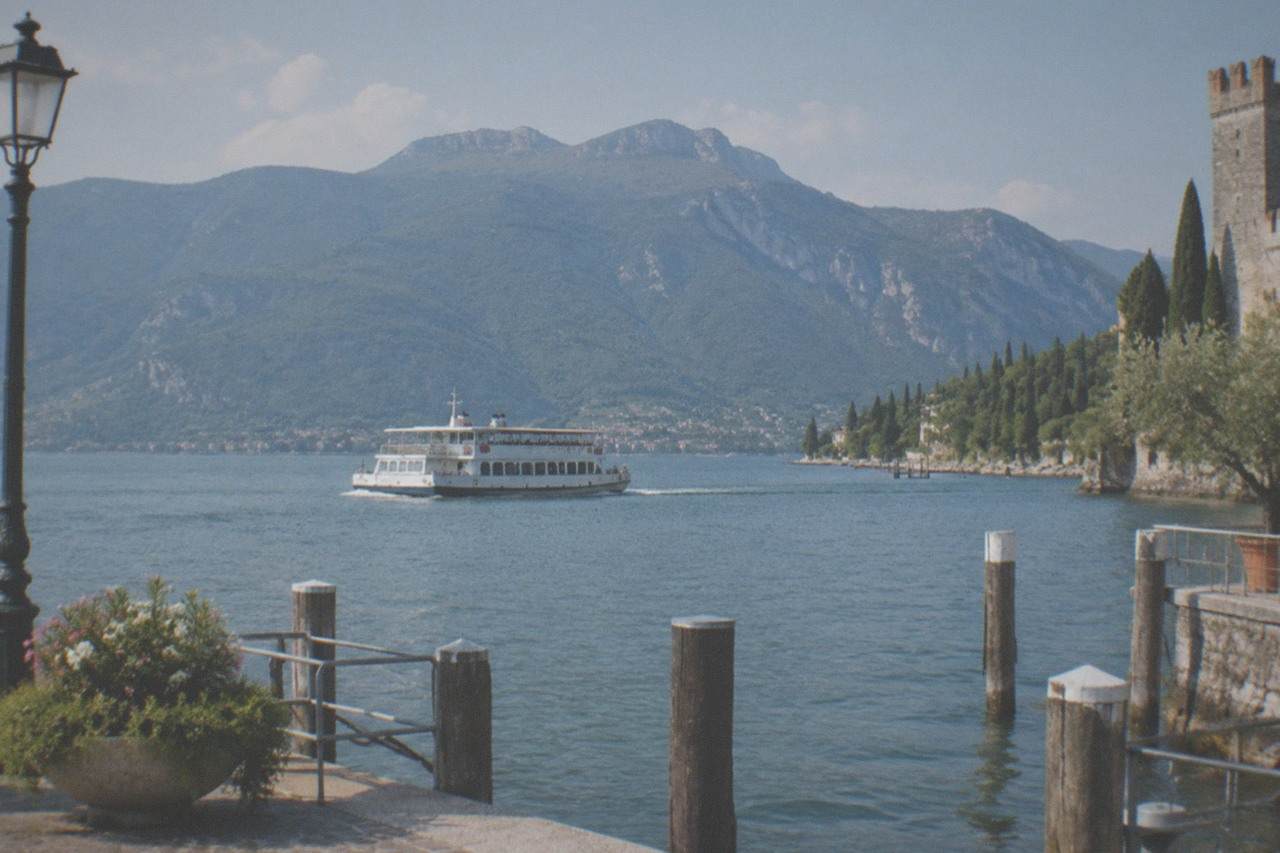
Yes, and it is often faster. Trains reach Desenzano del Garda and Peschiera del Garda, both a 15 minute walk from their ferry landings. The public boat network serves 28 landing stages, a whole-lake day pass costs 39.50 euro, and buses cover the towns the boats skip. Sirmione's restricted zone makes driving the slower choice anyway.
Lake Garda is the largest Italian lake, 54 km long with a shoreline of 125 km, and its two southern rail stations sit roughly 15 minutes on foot from the ferry piers. The public navigation company, Gestione Governativa Navigazione Laghi, runs scheduled boats to 28 landing stages, from Peschiera in the south-east to Riva del Garda in the north. A whole-lake day pass costs 39.50 euro. Meanwhile Sirmione, the lake's most visited town, operates a summer restricted traffic zone with fines from 83 to 333 euro. The arithmetic is simple: on this lake, the boat is not a scenic add-on for the car-free, it is frequently the fastest way between two points.
This guide lays out the full car-free toolkit: which towns the train reaches, how far the ferry network stretches, where buses fill the gaps, what the Sirmione driving restrictions actually say, what a car-free day costs, and which base town and which boat trip make a car pointless.
Can You Visit Lake Garda Without A Car?
Yes, comfortably, and for much of the lake it is the better way to travel. The Milan to Venice main line stops at Desenzano del Garda-Sirmione and Peschiera del Garda, each about a 15 minute walk from its ferry landing. From those two piers the public boat network reaches 28 landing stages, and a whole-lake day pass costs 39.50 euro, so the boat can replace most of the bus legs a car-free visitor would otherwise need.
The standard worry is that a lake this size, 54 km from end to end, needs wheels. The geography says otherwise. The lake itself is the corridor: nearly every town of consequence sits on the water, and the water has a scheduled, state-run passenger service on it. The ferry operator's summer timetable runs at full frequency from 16 May to 4 October, with a reduced spring and autumn service either side, and even in the off-season the main lines keep running. A traveller report from a June stay in Malcesine, car-free for a week, described getting about entirely by ferry and having no trouble boarding, while noting that queues grow later in the summer.
There are two honest caveats. First, the northernmost stretch, Riva del Garda and Torbole, sits at the end of the network, so reaching it from the south is a long sailing and you should check the last departures. Second, the lake's three administrative shores mean the boat is the only truly unified public transport here: there is no single lake-wide bus network, just regional services that change at provincial boundaries. Plan around the boats, use buses to patch, and the car becomes optional fast.
For the practical detail of timetables and ticket types, the companion guide to the Lake Garda ferry network covers every landing stage and fare zone.
Which Towns Are Reachable By Train?
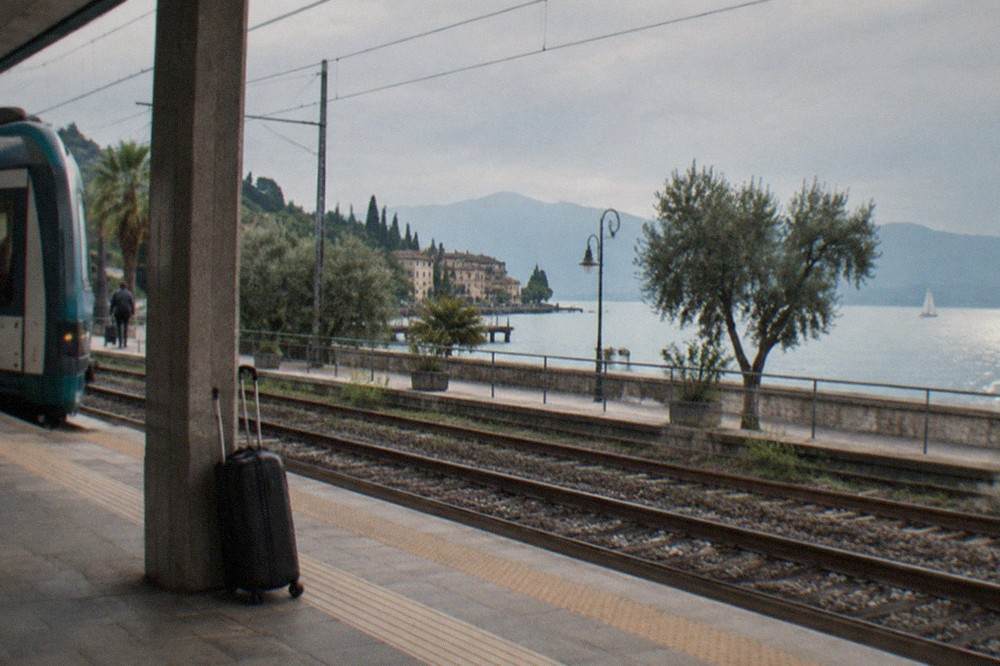
Two Lake Garda towns have main-line stations: Desenzano del Garda-Sirmione, with three platforms, and Peschiera del Garda, with two. Both sit on the Milan to Venice railway, and both are about a 15 minute walk, roughly 1.1 to 1.2 km, from their ferry landings. Every other town on the lake is reached from these stations by boat, bus or a combination.
Direct trains make the lake an easy add-on to a city trip. The fastest direct Trenord service from Desenzano to Milano Centrale takes about 83 minutes, so a morning train puts you at the water before noon. From Verona the hop is shorter still, and the day trip from Milan by train and the Verona to Lake Garda route each have their own planning guides. Trenitalia also sells a combined train-plus-day-boat-pass ticket to Desenzano or Peschiera, with the Basso Lago zone pass at 21.60 euro instead of the 27 euro walk-up price, valid for travel through the season.
The walk from platform to pier matters more than it sounds. At Desenzano the station sits at the top of the town, and the route down to the landing, about 1.1 km, passes through the newly finished lungolago promenade, whose final section between via Gramsci and vicolo delle Lavandaie opened in May 2026 after a project costing 3,140,000 euro. At Peschiera the walk is about 1.2 km and flatter, dropping through the UNESCO-listed Venetian fortress town to the harbour. Both walks are luggage-trolley friendly in dry weather.
The table below is the practical summary: which towns the train reaches directly, which need a boat or bus leg, and which are realistically road-only.
| Town | Train | Ferry landing | Bus | Car-free verdict |
|---|---|---|---|---|
| Desenzano del Garda | Yes, main line | Yes | Yes | Easiest base, station to pier in 15 minutes |
| Peschiera del Garda | Yes, main line | Yes | Yes | Easiest base, flat walk to the harbour |
| Sirmione | No, 10 km from Desenzano station | Yes | Yes | Boat or bus from either station |
| Bardolino | No | Yes | Yes | Ferry from Peschiera or Garda |
| Lazise | No | Yes | Yes | Ferry from Peschiera |
| Garda | No | Yes | Yes | Ferry from Bardolino or Torri |
| Malcesine | No | Yes | Yes | Long but scenic sailing from the south |
| Limone sul Garda | No | Yes | Limited | Ferry is the practical option |
| Riva del Garda | No | Yes | Yes | End of the line, plan the last boat |
| Salò | No | Yes | Yes | Ferry from Desenzano or Sirmione |
One planning note on tickets: the operator's NaviTap contactless system lets you buy a daily ticket on board with a tap of a contactless card or wallet, up to five tickets on a single device, which removes the queue at the ticket window on a tight connection.
How Far Does The Ferry Network Reach?
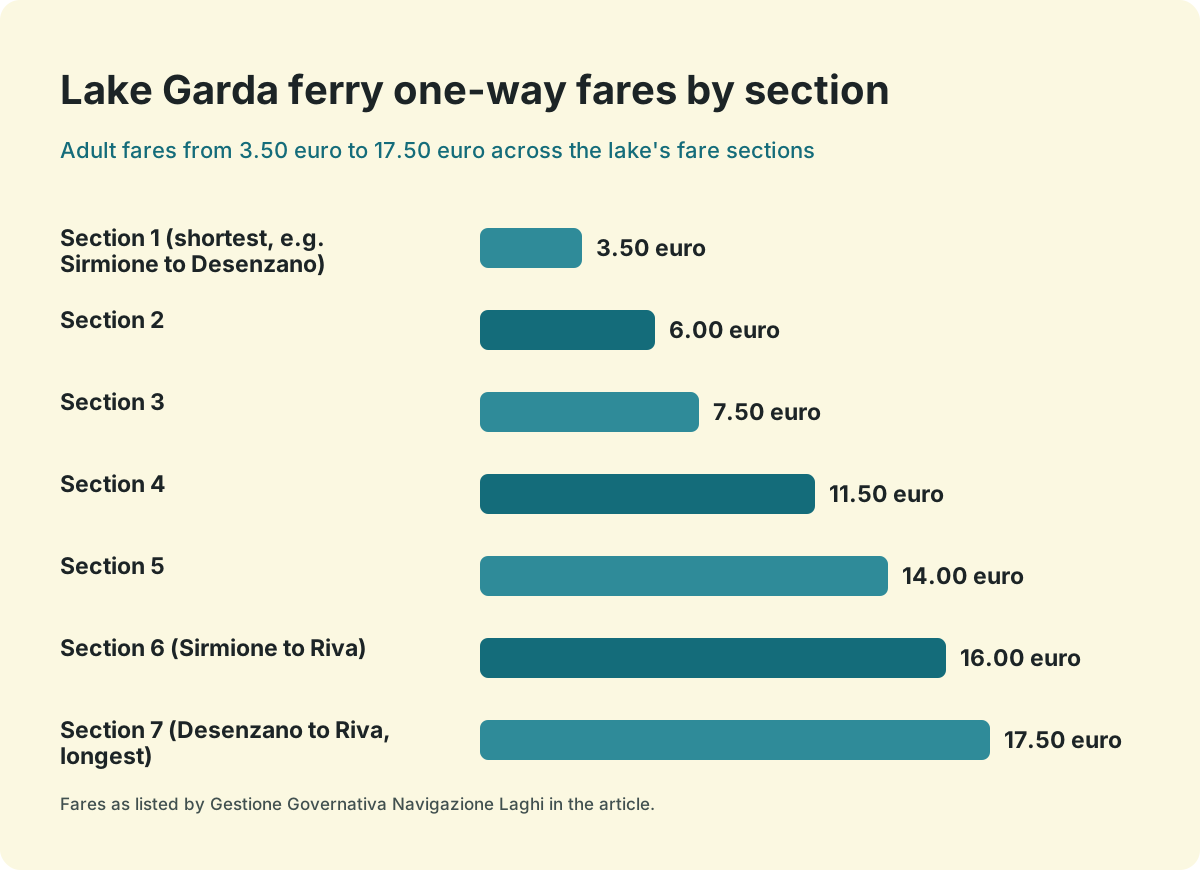
The network calls at 28 landing stages along the full 54 km length of the lake, from Peschiera del Garda in the south-east to Riva del Garda and Torbole at the northern tip. Adult one-way fares run from 3.50 euro for the shortest section, such as Sirmione to Desenzano, to 17.50 euro for the longest, Desenzano to Riva.
The fare system is built on sections rather than distances: you cross the row of your departure port against the column of your arrival port and read the section number. Section 1 costs 3.50 euro, section 2 costs 6.00 euro, and the scale runs up through 7.50, 11.50, 14.00 and 16.00 euro to 17.50 euro at section 7. Sirmione to Riva, nearly the whole lake, is section 6 at 16.00 euro. An urban hop costs 1.50 euro. Children under four travel free if they do not occupy a seat, and children from 4 to 11 pay the reduced column, for example 3.50 euro where the adult fare is 6.00 euro.
Crossing times on the southern basin are short. The summer timetable shows Desenzano departures reaching Sirmione in about 20 to 25 minutes. The full Lake Garda ferry guide explains the day pass zones in detail, and the question of whether the boats work as a hop-on-hop-off service has its own article: the short answer is that a day pass gives you unlimited boarding, but the boats are a scheduled point-to-point service, not a tour circuit, so check the hop-on-hop-off question before planning a multi-stop day.
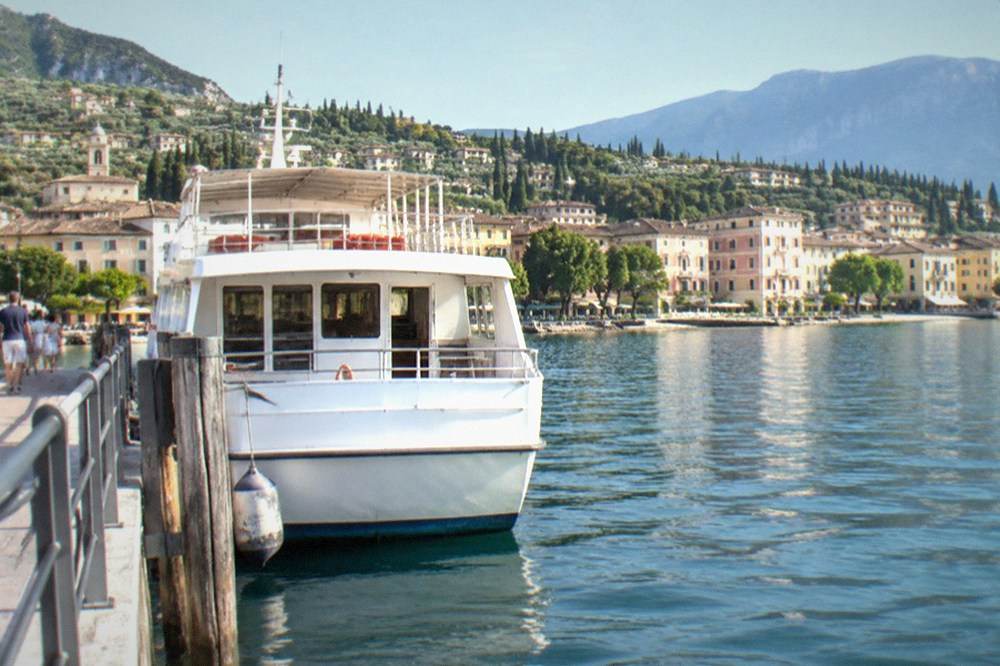
Two seasonal facts shape any car-free itinerary. The full summer timetable runs from 16 May to 4 October; outside that window frequency drops, though the main lines continue. And places are limited to the maximum capacity of each vessel, so on peak August weekends the boarding queue is a real thing, as the traveller report cited earlier confirms. Buying a day pass in advance at the ticket office, or tapping on board with NaviTap, removes one of the two queues.
Where Do Buses Fill The Gaps?
Buses matter mainly on the eastern shore, where they shadow the lake road between Peschiera, Lazise, Bardolino, Garda and up to Malcesine, and for inland towns the boats never touch. A Gardapass ticket, at 33.50 euro for 24 hours, covers unlimited travel on Arriva buses and Navigazione Laghi boats together, which is the single most useful ticket for a mixed bus-and-boat day.
The honest framing is that the bus is the backup, not the star. Where the ferry calls, the ferry is usually the better ride: it skips the summer traffic on the lakeside road and it lands you in the centre of each town, at the pier, rather than at a stop on the ring road. The bus earns its keep in three situations. First, early mornings and late evenings outside the ferry's operating window. Second, inland destinations such as the wine villages behind Bardolino. Third, the eastern shore express runs, which can beat a slow multi-stop sailing when you simply need to get from Peschiera to Malcesine fast.
The integrated Gardapass, sold through the season, is the car-free traveller's friend precisely because it does not force a choice: board the 8.00 ferry from Peschiera to Lazise, walk the town, then catch the bus onward to Bardolino when the next boat is an hour away. One ticket, both networks, 24 hours.
Sometimes the best replacement for a bus leg is not a bus at all but a bookable boat tour that departs from a station town. The half-day cruise with lunch from Peschiera del Garda runs four hours on the water with a meal included, from $72.30 per person, rated 4.4 from 849 reviews, and it turns the dead time between two train connections into the day itself: you step off the train, walk 15 minutes to the harbour, and let the boat do the sightseeing while you eat.
That pattern, station town departure, no transfer needed, is the one to look for when you plan car-free. Peschiera works because the station and the harbour are one walk apart; Desenzano works the same way, and both towns have enough departures across shared cruises, private boats and the public ferry that a spontaneous decision on the pier is usually possible in shoulder season.
Why Is Driving Into Sirmione Difficult?
Sirmione's historic centre is a restricted traffic zone under summer rules that run from 23 March to 13 October 2026, with access controlled by number-plate cameras and fines from 83 to 333 euro. On 31 peak days across the season the centre is fully pedestrianised between 14:00 and 19:00, closed to private vehicles entering or leaving. In short, the one town everyone drives to is the one town where driving is the worst option.
The zone is not a soft suggestion. Access requires prior authorisation, with the vehicle's number plate loaded into the camera system, and the categories are set by municipal ordinance. A tourist who follows a navigation app onto the peninsula without authorisation collects a fine. The 2026 flow-management plan, presented by Mayor Luisa Lavelli after the previous summer's crowding episodes, increased the pedestrianisation days from 26 to 31 and expanded the street-tutor service to 105 days, while the administration explicitly rejected a numerical visitor cap as legally unworkable.
The dates cluster on weekends and holidays from April to September: early April, the May holidays, Sundays through the summer, and September weekends. On those days, between 14:00 and 19:00, even residents need a priority pedestrian pass and hotel guests arrive through reserved arrangements at Piazzale Porto and Lungolago Diaz. The municipal notice board carries the current calendar, and the ZTL regulation page on the Comune di Sirmione site spells out the fine range.
| Rule | What it means for a visitor |
|---|---|
| ZTL summer season | 23 March to 13 October 2026 |
| Access control | Number-plate cameras, prior authorisation required |
| Fine for unauthorised entry | 83 to 333 euro |
| Pedestrianisation days | 31 days, 14:00 to 19:00, April to September |
| Pedestrianisation dates | April 4, 5, 6, 24, 25, 26; May 1, 2, 3, 30, 31; June 1, 2, 7, 14, 21, 28; July 5, 12, 19, 26; August 2, 9, 15, 16, 23, 30; September 6, 13, 20, 27 |
| Hotel-guest exception | Reserved spots at Piazzale Porto and Lungolago Diaz with luggage transport |
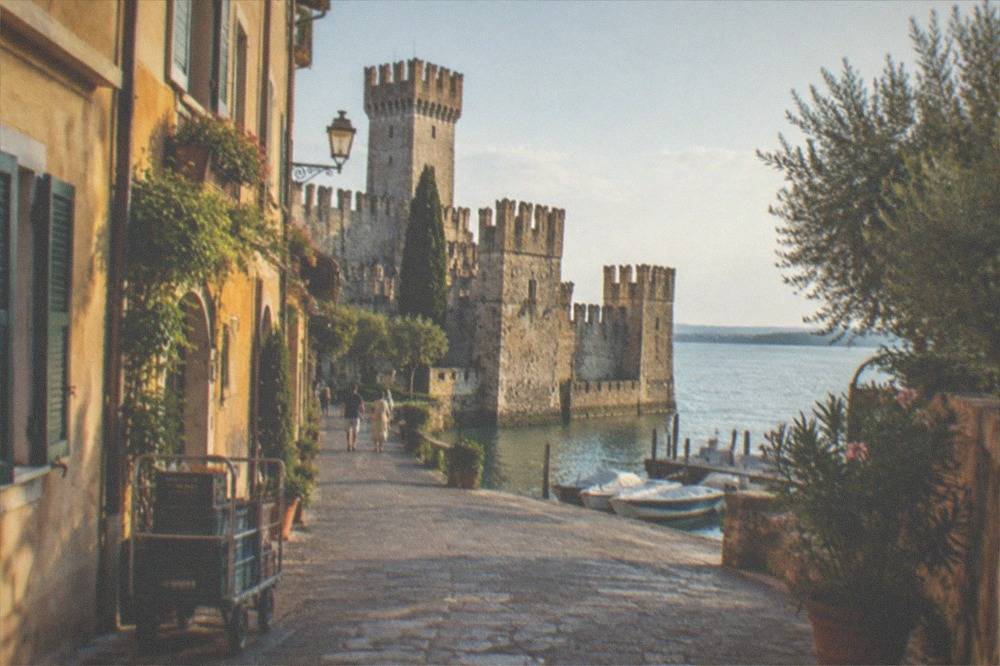
The car-free alternative is clean. The ferry from Desenzano takes about 20 to 25 minutes and lands you at the foot of the castle, inside the pedestrian zone, with no fine, no parking fee and no queue for a space. Even the public parking options outside the zone charge by the hour, and the shuttle from the peripheral car park adds another leg. The boat is not just equal to the car here, it is strictly better.
What Does A Car-Free Day Cost?
A whole-lake ferry day pass costs 39.50 euro per adult, an upper-or-lower-lake pass costs 27.00 euro and a single-zone pass costs 23.50 euro. One-way fares run from 3.50 euro for the shortest hops to 17.50 euro for the full lake, so a pass pays for itself on roughly three medium sections in a day.
The break-even is worth doing properly, because the wrong ticket is the most common car-free mistake. The day passes allow unlimited boarding for a calendar day: the whole-lake version includes the fast catamaran services, while the zonal versions cover ordinary routes only, with a supplement for the fast boats. The supplement scale runs from 2.50 to 6.00 euro per section. If your plan is two towns and back, single tickets are cheaper; if it is three landings or more, the pass wins.
| Ticket | Price (adult) | What it covers | Best for |
|---|---|---|---|
| One-way, section 1 | 3.50 euro | Short hops, e.g. Sirmione to Desenzano | Single crossing |
| One-way, section 2 | 6.00 euro | e.g. Peschiera to Sirmione | Single crossing |
| One-way, section 6 | 16.00 euro | Sirmione to Riva, most of the lake | One long sailing |
| One-way, section 7 | 17.50 euro | Desenzano to Riva, the full lake | One long sailing |
| Day pass, whole lake | 39.50 euro | All routes including fast services | Multi-town day |
| Day pass, upper or lower lake | 27.00 euro | Ordinary routes in one half | Regional day |
| Day pass, single zone | 23.50 euro | Ordinary routes in one zone | Two or three towns |
| Gardapass, 24 hours | 33.50 euro | Arriva buses and Navigazione Laghi boats | Mixed bus-and-boat day |
Beyond transport, the day's other costs are the ordinary ones of any Italian lakeside day, and they are covered in the town-by-town cost discussion elsewhere on this site. One figure worth knowing in advance: if you stay overnight, tourist tax applies, and it varies by town, from 1.25 to 2.50 euro per person per night in Peschiera del Garda up to 4.20 euro for a five-star hotel night in Sirmione, so a car-free itinerary spread across two bases carries a small extra per-head cost.
Which Base Works Best Without A Car?
Desenzano del Garda and Peschiera del Garda are the two strongest car-free bases, because each pairs a main-line station with a full ferry landing. Lazise and Bardolino work well as ferry-and-bus bases on the eastern shore, while Malcesine and Limone suit visitors happy to arrive by boat and stay put. Sirmione is the weakest driving base and one of the best boat bases.
The choice comes down to what kind of trip you want. Desenzano is the transport hub: the biggest southern pier, the station up the hill, and a new lakefront promenade that makes the walk between them pleasant. Peschiera is the gentler version, flat, compact, with the fortress walls between station and harbour, and it ranks among the busiest overnight towns on the Veneto shore, behind only Lazise, which the regional statistics table places first. Bardolino and Malcesine sit lower in the same regional table, which tells you where the crowds thin out.
Sirmione deserves a special word because its popularity cuts both ways. It remains the most visited locality on the lake in booking data, with a 14 percent market share, and Germany accounts for 28 percent of the lake's overnight stays overall, so summer weekends are busy in a way the smaller towns are not. But the same restricted zone that punishes drivers rewards boat arrivals. A base in Sirmione combined with the ferry to Desenzano, at 3.50 euro each way, is a genuinely relaxed formula. The where to stay on Lake Garda guide compares the towns for overnight stays, and the Lake Garda towns overview covers the character of each.
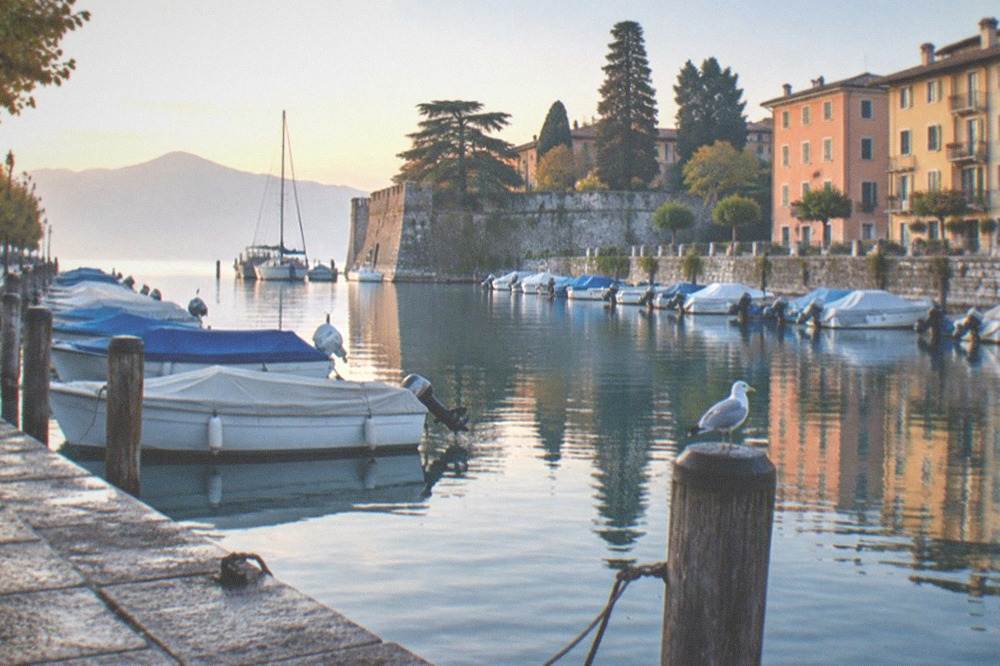
From a Peschiera base, the short Sirmione peninsula cruise is the natural first excursion: a 25-minute loop around the headland from $13.77 per person, rated 4.7 from 3,495 reviews, showing the Rocca Scaligera, the Grotte di Catullo cliffs and the thermal spring from the water, with departures from the Sirmione landing a ferry ride away.
For a base further from the stations, the calculus changes only slightly: the eastern-shore towns between Peschiera and Garda are all on both the ferry and the bus line, so Lazise, Bardolino and Garda function as interchangeable car-free bases, and the choice between them is about atmosphere rather than access.
Which Boat Trip Fits A Car-Free Day?
The best car-free boat trips depart from the station towns and return to them, so no transfer is needed. From Peschiera, the half-day cruise with lunch and the east-coast cruise to Sirmione both work. From Desenzano, the three-hour cruise to Sirmione with a stop replaces a bus leg outright. From Garda or Bardolino, the four-hour guided cruise to Sirmione covers the same ground for visitors staying mid-lake.
The principle is the one worth remembering: a bookable tour can do the job of a bus, and do it better. The three-hour cruise from Desenzano to Sirmione with a stop, from $40.17 per person and rated 4.2 from 257 reviews, sails you up to the peninsula, gives you time ashore in Sirmione, and brings you back, which is exactly the round trip a car would have done, minus the parking and the ZTL anxiety.
For visitors staying on the eastern shore without a station, the four-hour guided cruise to Sirmione from Garda or Bardolino, from $63.12 per person and rated 4.3 from 185 reviews, does the same job from further north. And for a pure taster, the 25-minute peninsula loop from Sirmione itself is the cheapest full sightseeing experience on the lake at $13.77. Every listing named here carries free cancellation, so a car-free itinerary can hold its boat day loosely and rebook around the weather.
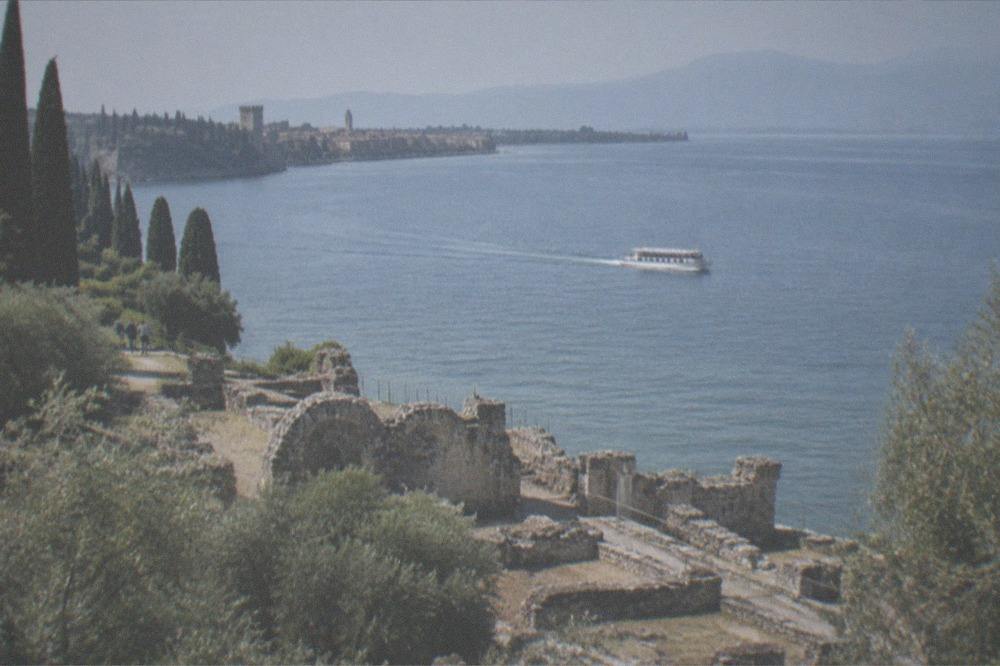
A sample car-free day ties it together. Take a morning train to Peschiera, walk to the harbour, and buy a lower-lake day pass at 27.00 euro. Ferry to Lazise for the morning, ferry onward to Bardolino for lunch, then either the boat back to Peschiera or, if the timetable leaves a gap, the bus with the same pass if you hold the Gardapass instead. Total transport cost for the day: under 35 euro, with no parking, no fines and no navigation. Multiply that pattern across a week and the case for arriving by train, as this site's Lake Garda Boat Tours coverage is built to show, is that the water was always the best road here.
Common Questions About Getting Around Lake Garda Without A Car
Can You Visit Lake Garda Without A Car?
Yes. Trains reach Desenzano del Garda and Peschiera del Garda, both about a 15 minute walk from their ferry landings, and the public boat network serves 28 landing stages along the full length of the lake. Buses fill the gaps on the eastern shore and for inland towns.
How Much Is A Whole-Lake Ferry Day Pass On Lake Garda?
A whole-lake day pass costs 39.50 euro per adult and includes the fast services. An upper-or-lower-lake pass costs 27.00 euro and a single-zone pass costs 23.50 euro, both covering ordinary routes only, with a supplement of 2.50 to 6.00 euro per section for fast boats.
Which Lake Garda Towns Have Train Stations?
Only two: Desenzano del Garda-Sirmione, with three platforms, and Peschiera del Garda, with two. Both are on the Milan to Venice main line. Every other lake town is reached from one of these stations by ferry, bus or both.
Can You Drive Into Sirmione?
The historic centre is a restricted traffic zone under summer rules running from 23 March to 13 October 2026, with camera enforcement and fines from 83 to 333 euro. On 31 peak days between April and September the centre is fully pedestrianised from 14:00 to 19:00. Arriving by ferry avoids all of it.
Do The Lake Garda Ferries Run All Year?
The main lines run year-round, but the full summer timetable, with maximum frequency, runs from 16 May to 4 October. Outside that window services are reduced, so check the operator's timetable for the last departures on any off-season car-free plan.
Is A Bus Pass Or A Ferry Pass Better On Lake Garda?
For most itineraries the combined Gardapass, at 33.50 euro for 24 hours of unlimited Arriva buses and Navigazione Laghi boats, is the best single ticket, because it lets you patch a slow ferry connection with a bus without buying a second ticket.