Is It Worth Going To Riva Del Garda?
An honest look at Riva del Garda: what the town offers, why motorboat tours are scarce on the Trentino water, what the wind does, and which northern boat trips are worth booking instead.
Is It Worth Going To Riva Del Garda?
Yes, if you are going for the setting rather than for a catalogue of boat tours. Riva del Garda sits at the narrow northern tip of the lake, where mountains close in on the water and the Ora wind arrives each afternoon. The old town is genuinely lovely, the swimming is good, and the one bookable boat departure from the town itself is a private speedboat for up to four people.
That last sentence surprises people who assume every Garda town works like Sirmione or Peschiera del Garda, where shared cruises leave on the hour. Riva does not work that way, and the reason is a law, not a commercial gap. The Trentino stretch of the lake, between Riva del Garda and Torbole, bans motor navigation outright under Provincial Law 9/2001, article 14, with exceptions only for authorised professional, rescue and limited fishing units, as the provincial administration's own authorisation page spells out. So the town that looks like the obvious base for a boat holiday is, on the water, the most restricted place on the entire lake.
That does not make Riva a bad choice. It makes it a specific one. Visitors who want to sail, windsurf, swim, walk and eat well in a handsome historic centre will do very well here. Visitors whose whole plan is a cheap shared cruise around a peninsula should base further south and visit Riva for the day, using the practical detail in our Riva del Garda boat trips guide.
For the boat options that genuinely suit the north, the shortlist looks like this.
The rest of this article takes the question seriously rather than answering it with a postcard. It covers what the town is actually like, what you can and cannot do on the water, why the departure list is so short, what the famous wind does to a day there, how to get there without a car, how it compares with Malcesine across the water, and finally which northern trip is worth your money.
What Is The Town Like?
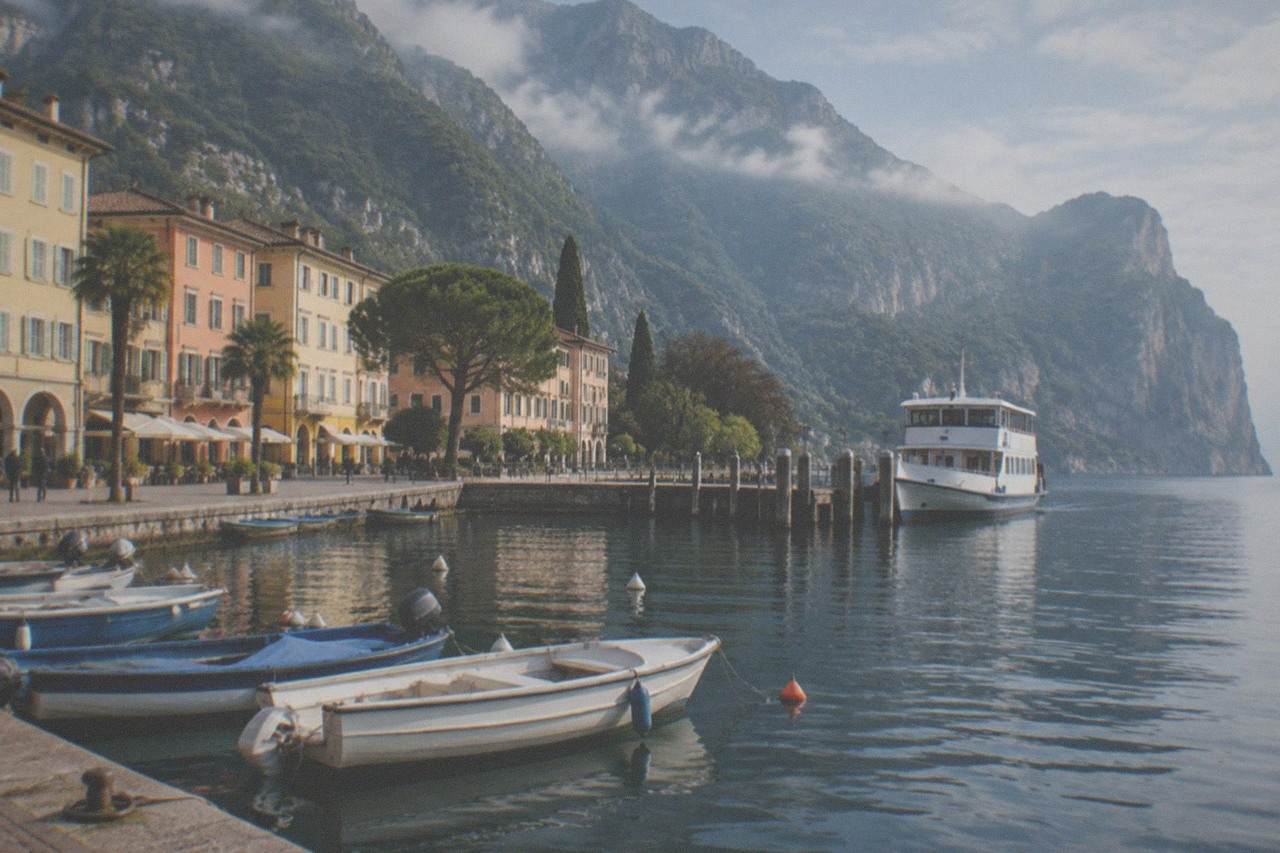
Riva del Garda is the largest town at the top of the lake, wrapped around a sheltered harbour and backed by cliffs that rise almost vertically from the shore. The old centre is compact and elegant, with a medieval tower, arcaded streets and a lakefront promenade lined with cafes. It feels alpine and Mediterranean at the same time, which is the honest reason it photographs so well.
The Apponale Tower has watched over the harbour square since the medieval period, and the surrounding lanes hold the mix of south Tyrolean and Venetian architecture you would expect from a town that changed hands between empires. The lakefront itself is the main stage: a wide promenade, lawned bathing areas and a view straight up the sheer face of Monte Rocchetta. On a clear evening the light on that cliff wall is the single best free show in the town.
Above the rooftops, the Bastione, a ruined Venetian fortress, sits on a ledge about 130 metres up. A panoramic lift runs there: the operator lists a single ride at EUR 6 and a round trip at EUR 10 in high season, 1 June to 30 September, EUR 9 the rest of the year, with the ascent covering 208 metres of track in about three minutes. It runs daily from 09:30 to 23:30 between mid-June and early October, then shorter hours to early November. The lift's own listing on the local tourism board carries the full schedule.
Ten minutes inland, the Cascate del Varone waterfall drops through a gorge; the site charges EUR 7 for an individual ticket, is open all year except 25 December, and needs about 20 minutes minimum on the paved path. Families and walkers fill the town in summer, and the beaches along the north shore are pebbly, clean and free to sit on.
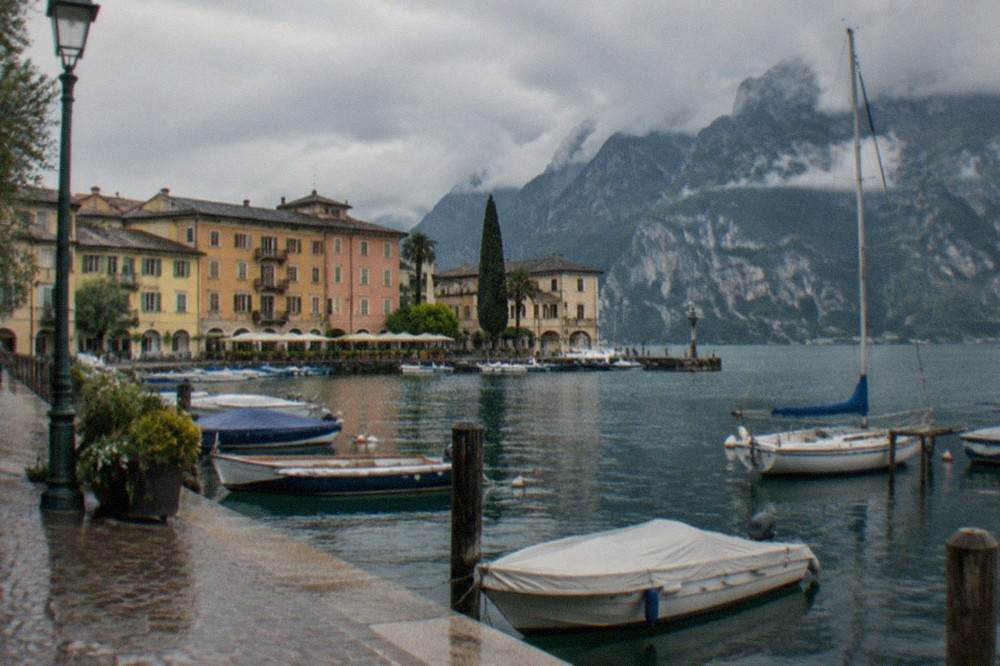
The town is also a genuine food base. Trentino cooking shows up in the restaurants more than the pasta-heavy menus of the southern shore: lake fish, speck, polenta and local whites. Prices sit a little under the Sirmione average, though we have no verified survey to quote, so treat that as a general impression rather than a figure.
If you are still building a picture of the whole lake, our Lake Garda towns overview places Riva in context against the southern resorts like Desenzano del Garda and the eastern villages. The short version: Riva is the town for people who want mountains with their lake.
What Can You Do On The Water There?
Honest answer: sail, swim, windsurf, or take the one private speedboat tour that departs from the town. There is no shared cruise, no hop-on boat tour and no self-drive motorboat rental from Riva, because powered craft are barred from the Trentino water. The sailing and the swimming are excellent; the motorboat menu is effectively one listing.
That one listing is the Riva del Garda luxury speedboat tour with a skipper. It runs one hour, takes up to four people, and is priced from $229.52 for the whole boat rather than per person. It rates 5 from 8 reviews, a small pool, so it earns no popularity claim here, but the score is strong and the listing carries free cancellation. For a family or a couple who want the wind-in-the-hair experience without breaking the law, it is the only game in town.
Everything else on the water at Riva is human-powered or sail-powered, and much of it is the better for that. The town is one of Europe's great centres for windsurfing and dinghy sailing precisely because the wind is so reliable; clubs and schools line the shore at nearby Torbole. Swimming is free along the pebble beaches, and the water at the top of the lake is clean and deep. Kayak and SUP rental operates from several spots along the north shore in summer.
The public ferry is the other way onto the water. Navigazione Laghi runs the passenger network, and Riva is the northern terminus: an adult one-way from Sirmione costs EUR 16.00 (fare section 6), from Desenzano del Garda EUR 17.50 (section 7), and a whole-lake day pass allowing unlimited hopping costs EUR 39.50 including the fast services. Those fares come from the operator's own 2026 tariff sheet. The Lake Garda ferry guide covers the routes in detail.
Here is what a day in and around Riva can hold, with the costs we can verify.
| Activity | Time needed | Cost |
|---|---|---|
| Bastione panoramic lift, round trip | 1 hour with the view | EUR 10 high season, EUR 9 otherwise |
| Cascate del Varone waterfall | 20 minutes minimum | EUR 7 individual |
| Old town and harbour walk | 1 to 2 hours | Free |
| Swimming at the north shore beaches | Half a day | Free |
| Ferry hop to Limone sul Garda | 30 minutes each way | EUR 6.00 one way, zone 2 fare per the Instagarda timetable listing |
| Private speedboat tour with skipper | 1 hour | From $229.52 for the boat, up to 4 people |
Note the pattern: Riva is a town where the best things are either free or cheap, and the single expensive water activity is the private speedboat. That is the inverse of Sirmione, where cheap 25-minute loops start from $13.77 per person and the free options are thinner.
Why Are There So Few Boat Departures?
Because the Trentino provincial law bans motor navigation on the water between Riva del Garda and Torbole, and the ban is total rather than seasonal. Article 14 of Provincial Law 15 November 2001 n. 9 prohibits powered craft, with narrow exceptions for authorised professional, rescue and resident fishing use. No operator can legally run a shared motor cruise from Riva's harbour.
This is the single most misunderstood fact about the northern lake, and it explains a whole cluster of online confusion. People read that "Lake Garda has dozens of boat tours" and assume Riva, the biggest northern town, must have its share. It cannot. The law exists to protect the area's sailing vocation: the Riva to Torbole basin is deliberately reserved for wind-driven and muscle-driven craft, which is why it hosts world-level sailing and windsurfing instead of sightseeing launches.
The geography matters too, and it is worth getting right. Malcesine, just across the water, is in Veneto, and Limone sul Garda is in Lombardy. Neither sits in Trentino water. So a boat that departs Malcesine can cruise north past Riva's cliffs under Veneto and Lombardy rules, while a boat based in Riva itself cannot even leave the harbour under power. Sirmione-based self-drive operators state the same thing from the other direction: their no-licence motorboats may not enter the Trentino area and cannot pass north of the height of Limone and Malcesine.
The practical consequence for a visitor is simple. If your heart is set on a motorboat day, base in Malcesine, Limone or further south and arrive at Riva by ferry or on foot. If your heart is set on Riva itself, plan around sail, paddle, swimming and the one skippered speedboat, and treat the ferry network as your sightseeing launch. The comparison piece on Malcesine versus Riva works through that trade-off in detail.
What Is The Wind Like?
The northern lake runs on a clockwork wind cycle. The Pelèr blows from the north through the morning, typically starting between 2 and 3 a.m. and fading around noon. The Ora then arrives from the south, blowing from around noon until sunset and funnelling stronger between the cliffs. On clear days the switch is almost punctual, and it defines every plan you make.
The local tourism board describes both winds precisely, and the winds page on Garda Trentino is the reference to read before your trip. The Ora is the famous one: it reaches speeds of over 10 metres per second and can produce significant waves as the lake narrows towards the north. That is heaven for sailors and windsurfers, and a genuine consideration for everyone else.
For a visitor, the cycle translates into three planning rules. First, do your swimming, SUPing and flat-water kayaking in the morning, while the Pelèr is gentle and the surface can be mirror-calm. Second, expect the waterfront to get blustery from lunchtime: cafe tables near the shore flap napkins, and the sailing schools come alive. Third, if you are taking a ferry or a boat trip in the afternoon, the crossing may be lively, and operators watch the forecast closely.
There are lesser winds too. The Balinot, a descending north-west wind that arrives via the mountains behind Riva, can exceed 20 metres per second and builds higher waves than the Pelèr. The Vinessa blows from the south-east for two or three consecutive days when Adriatic weather pushes in. Neither is common, but both explain the occasional day when the northern basin is rough while the south is calm.
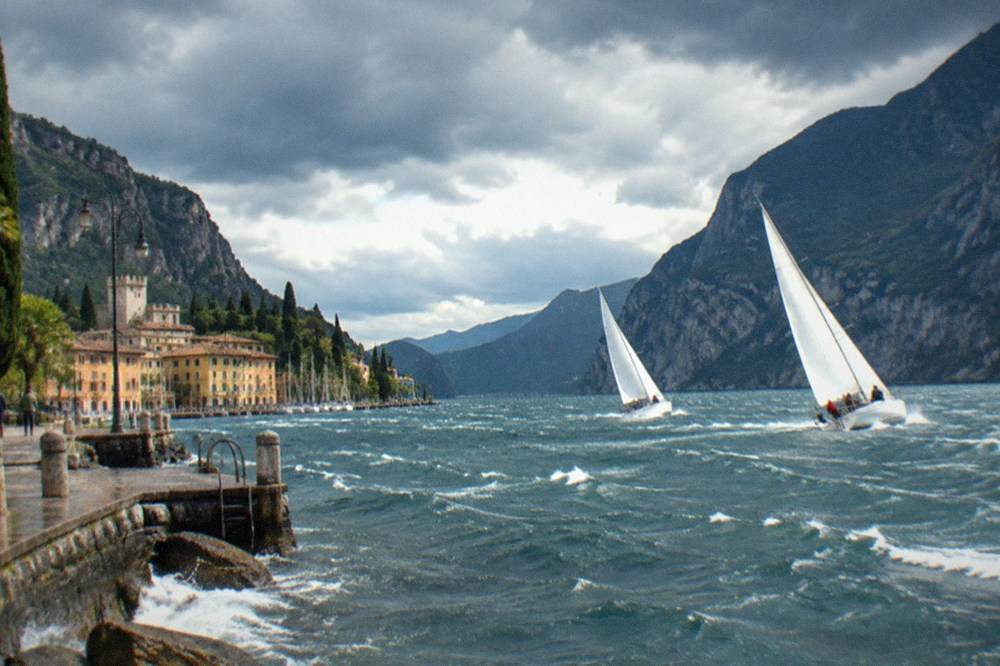
This wind engine is exactly why the north is a sailing destination rather than a motor-cruise destination, and why the best northern boat trips are sail-powered. Our Lake Garda sailing trips guide lists the sailboat options from the neighbouring Veneto shore, where the same Ora does the work without the Trentino legal ceiling.
How Do You Get There?
By train you go to Peschiera del Garda or Desenzano del Garda on the Milan to Venice line, then ferry or bus up the lake. By ferry, Riva is the northern terminus of the Navigazione Laghi network: EUR 16.00 adult one-way from Sirmione, EUR 17.50 from Desenzano. By car you follow the western or eastern shore road, and the drive from Verona airport to the Sirmione area alone runs about 42 minutes in free-flow traffic.
The ferry is the way most visitors without a car should arrive, because it turns the transfer into the day's best sightseeing. The whole-lake day pass at EUR 39.50 lets you break the journey anywhere, and the crossing from Limone sul Garda to Riva takes about 30 minutes on the summer timetable, a hop listed at the zone 2 fare of EUR 6.00. The summer timetable runs at full frequency from 16 May to 4 October 2026, after which the service thins for autumn and winter.
Here are the main routes up, with what each costs where we have a verified figure.
| Route | Mode | Verified cost or time |
|---|---|---|
| Desenzano del Garda to Riva | Ferry, one way | EUR 17.50 adult (fare section 7) |
| Sirmione to Riva | Ferry, one way | EUR 16.00 adult (fare section 6) |
| Peschiera del Garda to Sirmione | Ferry, first leg | EUR 6.00 adult (fare section 2) |
| Whole lake, unlimited stops for a day | Ferry day pass | EUR 39.50 adult, fast services included |
| Malcesine to Limone | Private shuttle boat | About 30 minutes, from EUR 11 adults, EUR 6 children 3 to 10 |
| On-board ticket purchase | Any ferry | EUR 1.00 surcharge per passenger |
By road, both shore roads reach the north, and parking in Riva is easier than in Sirmione though it still fills in August. The nearest airports are Verona Villafranca, about 42 minutes from the Sirmione area in free-flow conditions, and Milan Bergamo, roughly an hour to the Desenzano area; those are computed free-flow drives, so add margin for summer traffic. Travelling without a car at all is entirely workable, and our car-free Lake Garda guide maps the train, ferry and bus combinations.
One warning worth repeating: the last southbound ferries leave Riva earlier than visitors expect, especially from early October when the timetable steps down. A missed connection means a bus, and a traveller report from summer 2026 describes exactly that, hours spent queueing for ferries and the cable car and a missed last direct sailing. Check the day's timetable at the pier in the morning, not in the evening.
How Does It Compare With Malcesine?
Malcesine, 30 minutes south by shuttle boat, is the better base if you want boat trips, because it sits in Veneto water where motor tours are legal. Riva is the better base if you want the town itself: bigger, flatter, with more restaurants and a grander alpine setting. Malcesine has the castle and the cable car; Riva has the waterfront and the space.
The two towns are natural rivals and most visitors with a week will see both. Malcesine is smaller and more vertically stacked, a scramble of lanes under the Scaliger castle, with the Funivia cable car rising from the edge of town to Monte Baldo at 1,760 metres. Riva is the working hub of the north, with the bigger harbour, the wider promenade and the lift to the Bastione. Malcesine feels like a film set; Riva feels like a small city that happens to be on a lake.
On the water the comparison is not close, and it favours Malcesine hard. Because Malcesine lies in Veneto, its operators can run cruises north along the cliffs legally, and the roster reflects that: a panoramic sailboat cruise from Malcesine runs 2 hours from $45.90 per person, rating 4.2 from 335 reviews, and a romantic version of the same sail rates 4.7 from 59 reviews at $57.38. The Malcesine boat trips guide lists the full set, including crossings to Limone.
Crowding splits the difference. Malcesine recorded just under 1.2 million overnight stays in 2024 in the regional statistics, and its lanes feel every one of them in July and August. Riva absorbs visitors more easily thanks to its size, but its beaches and the Bastione lift queue badly on peak weekends. German holiday dates drive the August surge, with Bavaria's summer holidays running from early August to mid-September, so early July or September visits dodge the worst of it.
The honest summary: stay in Riva if the town and the windsports appeal, and take the shuttle or ferry to Malcesine for boat trips. Stay in Malcesine if the boat menu is the point, and visit Riva for a day of waterfront, waterfall and lift. The Malcesine or Riva comparison exists for exactly this decision.
Which Northern Boat Trip Should You Book?
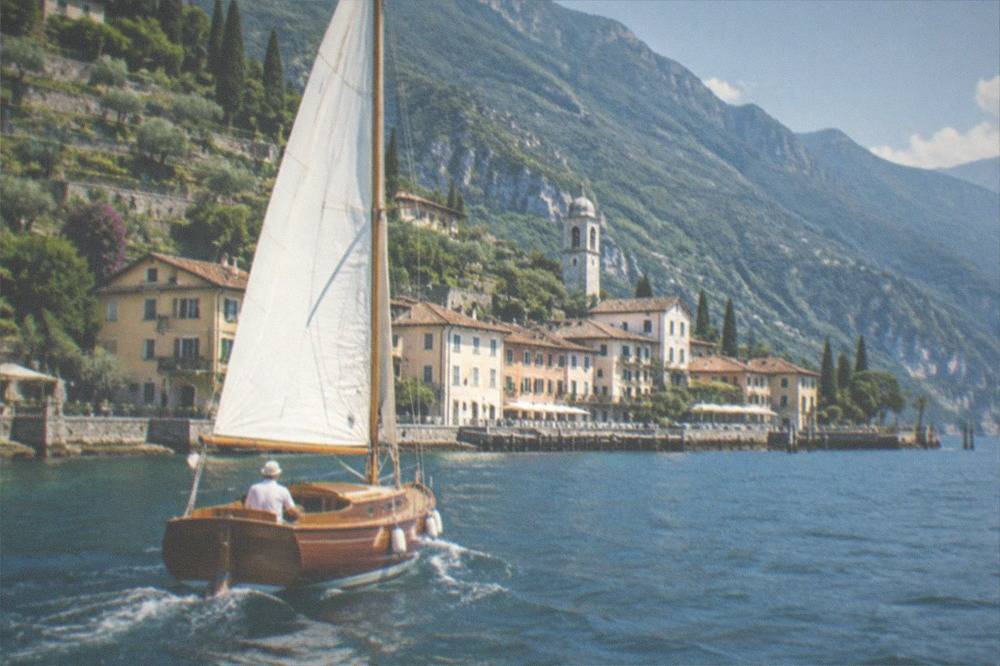
If you are staying in Riva, book the one-hour private speedboat with skipper, from $229.52 for up to four people. If you can reach Malcesine, book the two-hour historic sailboat cruise from $45.90 per person, which rides the Ora the way the north is meant to be seen. If you are based at the northern hotels around Limone, the 8-hour tour with boat trip from $78.04 covers the day.
Start with the sailboat, because it is the trip the north was built for. The Malcesine panoramic cruise on a historical sailboat runs two hours, rates 4.2 from 335 reviews, and departs from the Veneto shore where the wind does the propulsion. An afternoon departure catches the Ora at full strength, which is the whole point: this is the cruise where the lake's famous weather becomes the entertainment rather than a risk.
The Riva speedboat suits a different mood: a short, private blast with a local skipper, one hour, up to four people, from $229.52 for the boat. It rates 5 from 8 reviews, a small pool we will not dress up, and it carries free cancellation on the listing. Book it for the hour after the morning calm, and let the skipper handle the wind.
The third option serves the hotels strung along the north shore at Limone sul Garda: an 8-hour tour from $78.04 per person, rating 4.5 from 9 reviews, a small pool again, but the format is the most convenient for visitors already based in the north-west. It pairs the boat trip with a full day of sightseeing rather than a single crossing.
Here is how the northern options line up side by side.
| Departure town | Format | Price | Rating and reviews | Duration |
|---|---|---|---|---|
| Riva del Garda | Private speedboat with skipper | From $229.52 for the boat, up to 4 people | 5 from 8 reviews | 1 hour |
| Malcesine | Shared historic sailboat cruise | From $45.90 per person | 4.2 from 335 reviews | 2 hours |
| Malcesine | Romantic historic sailboat cruise | From $57.38 per person | 4.7 from 59 reviews | 2 hours |
| Limone sul Garda | Full-day tour with boat trip | From $78.04 per person | 4.5 from 9 reviews | 8 hours |
| Malcesine to Limone | Private shuttle crossing | From EUR 11 adults | Not a tour, a transfer | About 30 minutes |
One crossing question comes up constantly: how long the boat ride from Malcesine to Limone takes. The answer sits in our Malcesine to Limone crossing time piece, and the short version is about 30 minutes by the private shuttle, with the official ferry on the same corridor. For planning a two-town day, budget the crossing plus an hour in Limone and you have a realistic morning.
Whichever you choose, book around the wind rather than the clock. Morning departures give calm water and the Pelèr; afternoon departures give the Ora, bigger waves and the more dramatic photographs. Both are worth doing once. The team behind Lake Garda Boat Tours rates the afternoon sail from Malcesine as the single best-value water experience in the north.
For a final side-by-side of the three northern picks, here they are together.
Common Questions About Riva Del Garda
Is It Worth Going To Riva Del Garda?
Yes, for the setting, the old town, the windsports and the swimming. It is not worth going if your only goal is a long menu of shared motorboat tours, because the Trentino motor ban means the sole bookable departure from Riva itself is a one-hour private speedboat for up to four people. Base there for the town, and take boat trips from Malcesine.
Why are there no shared boat tours from Riva del Garda?
Provincial Law 9/2001, article 14 prohibits motor navigation on the Trentino water between Riva del Garda and Torbole, with exceptions only for authorised professional, rescue and limited fishing use. No operator can legally run a shared motor cruise from Riva's harbour, so the boat menu sits across the water in Malcesine, which is in Veneto.
What is the best time of day on the water at Riva?
Morning, before the Ora arrives around noon. The Pelèr blows gently from the north through the morning and the surface is often calm, which suits swimming, kayaking and paddleboarding. After noon the south wind funnels between the cliffs and the basin gets lively, which suits sailors and the sailboat cruises from Malcesine.
How do I get from Riva del Garda to Malcesine by boat?
Take the Navigazione Laghi passenger service or the Garda Express private shuttle. The shuttle runs the crossing in about 30 minutes from EUR 11 for adults and EUR 6 for children aged 3 to 10, with departures from Malcesine between 09:30 and 15:30 in the September schedule. Check the day's timetable before committing to an evening return.
Is Riva del Garda good for a day trip from the south of the lake?
Yes, and the ferry is the best way to do it. An adult one-way from Sirmione costs EUR 16.00 and from Desenzano del Garda EUR 17.50, or a whole-lake day pass at EUR 39.50 lets you break the journey at Limone or Malcesine. Leave early enough to catch an afternoon return sailing, since the last departures move earlier after early October.
Can you swim in Lake Garda at Riva del Garda?
Yes. The north shore has pebble beaches with clean, deep water, and the bathing areas along the Riva waterfront are free to use. Swim in the morning before the afternoon wind picks up, when the surface in the northern basin can chop up quickly.